


Getting a bird feeder can be dangerous- a slippery slope that might lead you to download bird guides, become semi-obsessed with identification, and maybe even compel you to invest in a pair of binoculars.
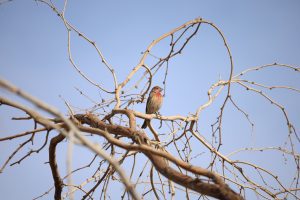
The main villain in this journey is likely to be the house finch. This sassy red songbird has developed a reputation for capturing the attention of friends and family members perhaps more than any other local bird, and I tend to get the most identification requests for it as well. House finches are aptly named as they are very common in suburban environments, and are often found nesting in eaves, backyard trees, and even wreaths left on front doors. The males’ red-orange hue gives them a beautiful contrast to their winter surroundings, making it the western equivalent to the ubiquitous cardinal seen throughout the Eastern US. Although females lack the red color, they make up for it in attitude. At my bird feeder this winter, I’ve noticed a system that finch couples will set up to maximize their time at the feeder. The male tends to perch atop the feeder and glare at, or chase off, any intruders while the female happily munches away at her seeds. This seems to lead to more time spent at the feeder overall, compared to when a bird arrives alone, without a lookout, and spends extra time and energy trying to fend off other hungry birds. When another bird dares to dart for the seed tray anyway, the female launches a swift, feathery assault to chase off the intruder!
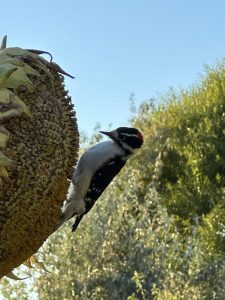
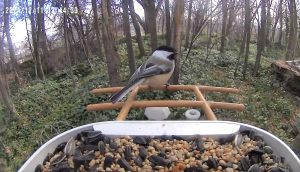
But house finches are not the only adorable birds that might get you addicted to watching your bird feeder. This winter, my first with a bird feeder in three years of avid birdwatching, I’ve seen downy woodpeckers, lesser goldfinches, dark-eyed juncos, and black-capped chickadees, all happily snacking from the feeder (and usually being polite and taking turns). I started to notice different patterns in each species. Chickadees only grab a single black sunflower seed before quickly darting off to cache it for later. Goldfinches politely share the feeder. And downies look confused as they angle their necks to the side in between feeding.
.
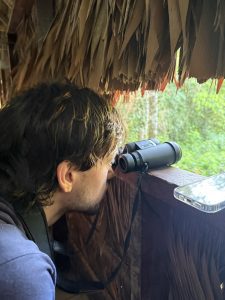
A good pair of binoculars is highly recommended to get the full bird feeder experience. You’ll be surprised how much more color, texture, and personality you’ll notice when looking through some quality glass. But if you don’t have high-quality binos, another great option is to splurge on a bird feeder with a camera. There are several options out there, but they all give you an endless supply of quirky moments from an unflattering and hilarious angle. That’s how I first noticed that a downy will contort its neck amusingly while looking straight at the camera. The fact that downies are slightly less frequent visitors makes the spectacle all the more rewarding.
My final recommendation for the uninitiated is to make sure you get a bird seed mix based on your region. For example, a “Western” mix that covers most of the Western US states will suffice. Doing so will make sure your bird visitors have food to choose from that’s as natural and region-appropriate as possible. The only things to avoid are wheat and cracked corn, as they are cheap filler grains that birds tend to ignore anyway.
Winter is a tough time for bird survival. Wild food sources are scarce, and many birds, especially juveniles going through their first winter, struggle to survive. Bird feeders are a great way to support overwintering populations and enjoy a little quirky side of nature at the same time. I’m always surprised by how much seeing the birds lifts my mood and entertains me. As “dangerous” as that may sound, getting into some light backyard birdwatching has been one of the highlights of my winter, and I’m looking forward to learning what birds and behaviors I’ll see once summer comes.